

CENSORED
How the establishment tried to kill a story and why it didn't work

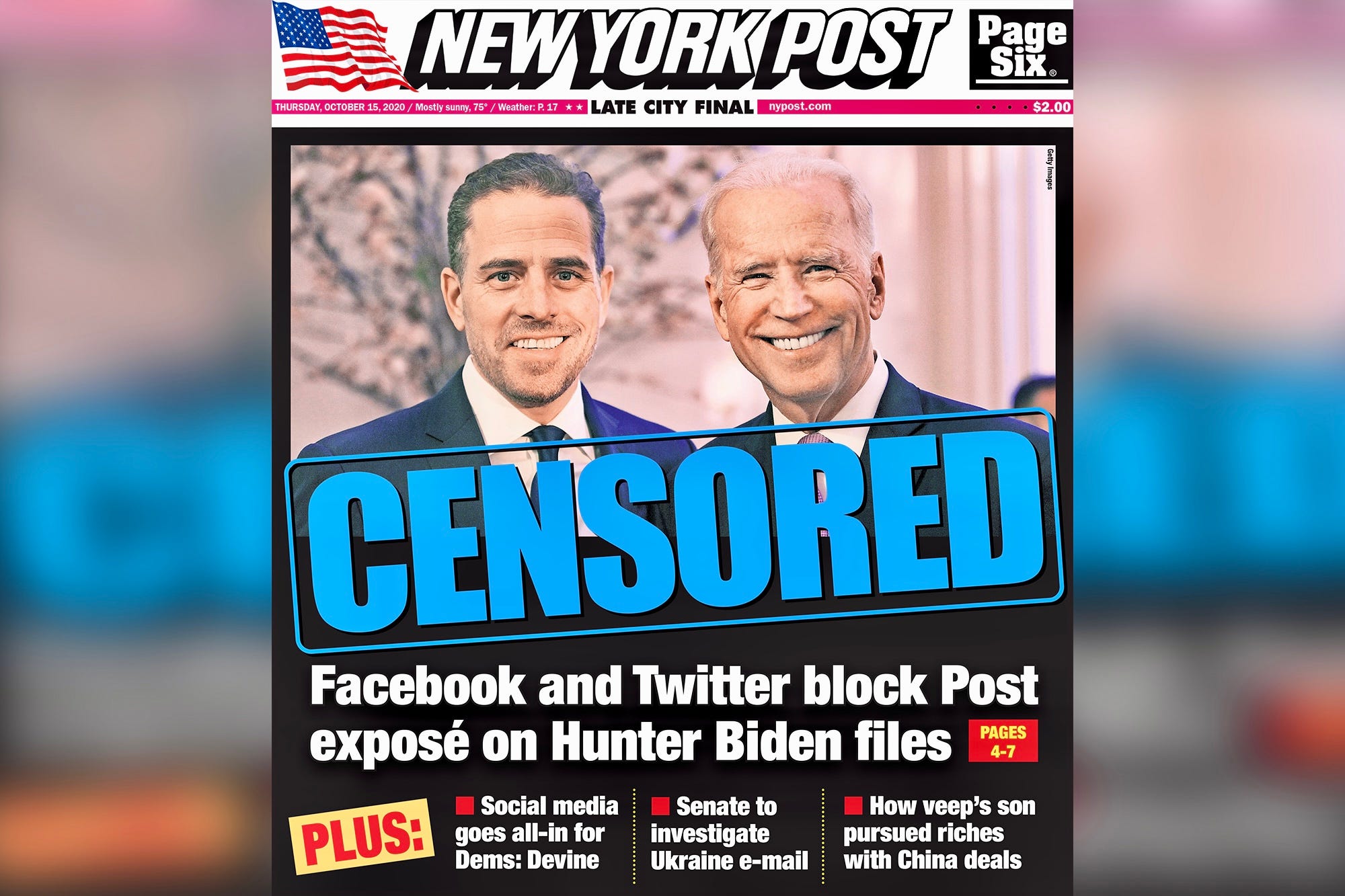
On October 15, 2020, three weeks before the US presidential election, the New York Post broke a bombshell story detailing lurid allegations of drugs, prostitution and influence peddling by Hunter Biden, the troubled son of Democrat nominee Joe Biden. For a moment it threatened to be the determining factor in a knife-edge race between President Donald J. Trump and his Democrat challenger. But the broadcast and print media ignored the story. The Post’s Twitter account was locked, and Facebook’s algorithms prevented the story from spreading across its platform.
An old school Rupert Murdoch newspaper had dropped an October surprise into the middle of a presidential election, and the establishment media and tech oligarchs didn’t debate it or challenge it. They shut it down, or at least they thought they did.
The story of course didn’t die, it bubbled beneath the surface for 18 months until the New York Times quietly confirmed that the laptop was authentic. In August 2024, Facebook’s Mark Zuckerberg wrote to the House Judiciary Committee admitting that the social media giant shouldn’t have demoted the story and that they’d changed their policies and procedures to ensure that this didn’t happen again.
NPR’s CEO Katherine Maher later admitted that they had been “mistaken” in failing to cover the Hunter Biden story more aggressively. Veteran NPR editor Uri Berliner was more candid. In a devastating essay, he wrote that the view from some NPR journalists at the time was that it was good that they weren’t following the story because it could help Trump.
“When the essential facts of the Post’s reporting were confirmed and the emails verified independently about a year and a half later, we could have fessed up to our misjudgement. But, like Russia collusion, we didn’t make the hard choice of transparency”, wrote Berliner.
The Hunter Biden story proved to be explosive for many reasons, but it was by no means the first attempt at suppressing an inconvenient story. Since the emergence of the media barons in the early twentieth century there has been an unholy struggle between politicians, newspaper proprietors and editors to set the agenda of the day. Commercial interest, public interest, and the most important interest of them all, self-interest, each compete to exert varying degrees of influence over the news of the day.
Veteran editor Eric Beecher who ran Murdoch’s Herald and Weekly Times in Melbourne in the late 1980s, illustrated the point perfectly in his book The Men Who Killed the News recalling the time when he led the front page with the story of a jumbo jet that had crashed in Taiwan killing 200 people. The next day Beecher received a call from Ken Cowley, the managing director of News Corp Australia.
“Don’t you know we own half an airline?” Cowley exclaimed. “We don’t run stories about plane crashes on the front page!”
As news media has expanded over the twentieth century, first in print and then television, their ability to gatekeep, censor or simply set the agenda of the day has become increasingly difficult. But social media platforms, with their section 230 exemption shielding them from defamation liability that every traditional publisher faces, has completely changed the game (whilst section 230 is admittedly a US law, in practice, it has global influence).
By protecting social media platforms while leaving individual writers liable, the law has quietly weakened institutional gatekeeping and many of the competing interests that shape editorial decision-making and which have bedevilled editors such as Beecher.
Ironically, in many cases, it may now be more difficult to silence an account on X or a writer on Substack who believes that the facts are on their side and that the public interest demands publication. By contrast, a corporate publisher looking at the same story but weighing an entirely different and more complex set of competing interests may favour caution, delay or silence.
The old gatekeepers undoubtedly still possess enormous power but they no longer hold a monopoly on publication. That is the real lesson from the Hunter Biden story.
A few years ago, a long-time New Zealand journalist and editor remarked to me that Substack writers and bloggers operate as a modern-day samizdat, the underground system whereby dissidents published political pamphlets that circumvented the censorship regime instituted by the Soviet Union.
Because of this modern-day samizdat, stories no longer live or die according to whether a small number of editors decide they should. They travel across fragmented media networks of journalists and independent writers accumulating attention regardless of whether institutional media chooses to engage with them.
An individual on X or Substack operates under a very different incentive structure. They can move faster, take greater risks and publish stories that corporate media may hesitate to touch. Sometimes that produces irresponsible nonsense. Other times it produces journalism that the corporate media will need to follow and validate. But either way, it means that the old model of gatekeeping barely exists.
That is why attempts to restore the old order through greater regulation, ‘fact-checking’ frameworks, legal threats and the delegitimisation of independent writers are unlikely to succeed. The information ecosystem is now simply too decentralised, too fast-moving and too porous.
Suppression increasingly fails for the same reason censorship has always struggled: the act of suppression becomes part of the story itself.
This doesn’t mean that mainstream journalism is dead. It simply means that its function has changed from being a gatekeeper to one that curates, annotates and verifies information that often breaks first elsewhere. The public often read news that they have already become aware of but they are interested not only in the story itself but also in evaluating how the story is framed by a particular media organisation. They want to see editorial judgment that is accurate and fair. When they sense ideology or gatekeeping, it immediately affects trust.
Zuckerberg admitted as much to the podcaster Joe Rogan in January 2025 when he observed that since the Covid and Hunter Biden stories, “I think generally trust in media has fallen off a cliff”.
The public are increasingly sceptical of the media’s claim to neutrality. But they still expect editorial judgment to be applied consistently and fairly. The moment editorial decision-making appears to be based on ideology, political consequence or an outmoded gatekeeping mentality, trust is eroded. And in a decentralised media environment, trust is incredibly difficult to rebuild.